








- Latest Products

- Latest Products
- Latest Products
- Latest Products
- Latest Products
- Latest Products
- Latest Products
- Latest Products
- Latest Products
- Latest Products
- Latest Products
- Latest Products
- Latest Products
- Latest Products
- Latest Products
- Merchandise


Reduce Your Carbon Footprint While Driving


How to Reduce Your Carbon Footprint While Driving
Transport accounts for around 18.8% of Australia’s annual greenhouse gas emissions, according to the DCCEEW. For most Australians, the family car is the single biggest contributor to their personal carbon footprint.
Switching to an EV is one option, but it is not the only one.
Eco driving is a set of practical habits that reduce how much fuel your car burns, cutting both your emissions and your fuel bill at the same time. The techniques are straightforward, they work with any vehicle, and most of them cost nothing to start.
Here is what eco driving actually looks like in practice, including one strategy that most guides skip entirely.
What Is Eco Driving?
Eco driving refers to a style of driving, and a broader approach to vehicle use, that minimises fuel consumption and emissions without sacrificing safety or journey times.
Research from the RACQ shows that eco-aware drivers use 10 to 15% less fuel than drivers without eco driving habits.
That adds up to real money over a year, and real reductions in emissions over a lifetime of driving.
Eco driving is not just about how you press the accelerator. It covers how you maintain your vehicle, how you plan your trips, and how you manage your car’s internal environment, including how hard your air conditioning has to work.
Why Air Conditioning Is a Bigger Problem Than Most People Realise
If there is one eco driving topic that consistently gets overlooked, it is this:
Your car’s air conditioning system can reduce fuel efficiency by more than 25% in very hot conditions, according to the US Department of Energy. On a 40-degree day in Sydney or Perth, your AC is working at full capacity for much of the drive.
The fix is not to suffer in silence through summer. It is to reduce the amount of heat building up in your car before you even start driving.
When a car sits in the sun, the cabin can reach 60 to 70 degrees Celsius within minutes. Your AC then has to work extremely hard to bring that space down to a comfortable temperature.
This is where the biggest efficiency gains are hiding.
The Speed Crossover Point Worth Knowing
There is a practical question about whether to use AC or open your windows.
At speeds under approximately 60 km/h, opening your windows is generally more fuel-efficient. Above 60 km/h, the aerodynamic drag from open windows starts to exceed the cost of running the AC, making climate control the more economical choice.
Knowing this crossover point helps you make smarter decisions depending on where and how you are driving.
Practical Eco Driving Techniques
The following habits, used together, make a significant difference to your fuel consumption and carbon output.
Smooth Acceleration and Anticipation
Aggressive acceleration is one of the most fuel-expensive things you can do behind the wheel.
Anticipating what is ahead and letting the car slow naturally when traffic stops, rather than braking hard at the last moment, keeps fuel consumption low and reduces brake wear at the same time.
Maintain a Steady Speed
Speed fluctuations burn significantly more fuel than steady-speed driving.
Research shows that fluctuating between 75 and 85 km/h every 18 seconds can increase fuel consumption by up to 20% compared with driving at a constant speed, according to the US Department of Energy.
On motorways, cruise control helps keep things consistent.
Keep Your Tyres Properly Inflated
Under-inflated tyres increase rolling resistance, which means the engine works harder to maintain speed.
Research from Natural Resources Canada shows that tyres under-inflated by 56 kPa can increase fuel consumption by up to 4%.
Tyre pressure checks are free, quick, and available at most service stations.
Avoid Unnecessary Idling
A modern car burns fuel every second the engine runs, even when stationary.
Turning the engine off during waits longer than 30 to 60 seconds saves fuel and reduces localised emissions in areas where children are breathing nearby, such as during school pickup.
Reduce Aerodynamic Drag
Roof racks, bike carriers, and roof boxes dramatically increase aerodynamic drag and therefore fuel consumption.
Remove them when not in use. The Australian Green Vehicle Guide notes that aerodynamic drag can increase fuel consumption by over 20% in some cases.
Travel Light
Every extra kilogram in your car adds to the fuel required to move it.
Clearing the boot of anything that does not need to be there is a simple, free improvement.
Plan Your Trips
Combining multiple errands into one trip reduces overall fuel consumption significantly.
Cold engine starts and very short journeys are disproportionately expensive in fuel terms. Route planning also helps you avoid congestion, where stop-start driving burns considerably more fuel than steady cruising.
How Window Shades Reduce Your Car’s Carbon Footprint
This is the strategy most eco driving guides miss entirely, and for Australian drivers, it is one of the most impactful.
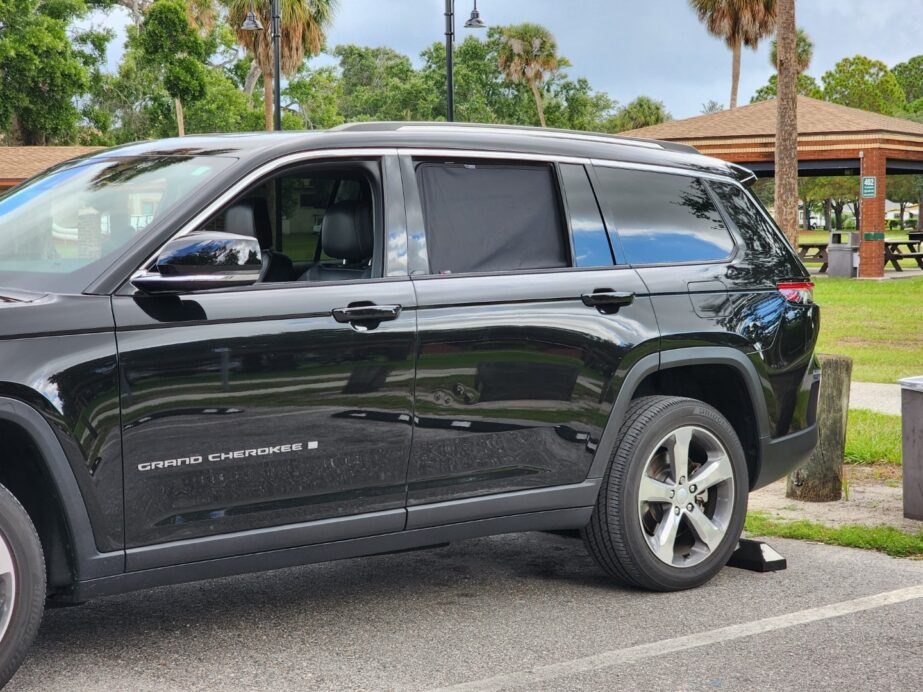
Car window shades reduce the heat that builds up inside your car, which means your air conditioning starts from a lower base temperature and does not have to work as hard.
Less AC use means less fuel burned, fewer emissions, and lower running costs across every journey where the sun is a factor.
Snap Shades are designed to block up to 84.6% of UVA and UVB radiation, tested and verified by ARPANSA (the Australian Radiation Protection and Nuclear Safety Agency).
By managing the heat that enters through your windows, particularly the rear and side windows where passengers sit, you directly reduce the AC load your engine has to carry.
In practical terms: a cooler car when you get in, shorter AC run times to reach a comfortable temperature, and lower fuel consumption on every hot day.
Given that Australian summers can run for months of 35 to 40-plus degree days, that is a meaningful saving across a season.
The Compound Effect: Small Changes Add Up
Each of these strategies makes a modest difference on its own. Combined, they add up to something more significant.
If eco driving habits reduce fuel consumption by 10 to 15%, and reducing AC load through window shades saves a further 5 to 10% in hot weather, a family doing 15,000 km per year in a 7L/100km vehicle could save between 100 and 200 litres of fuel annually.
That translates to real reductions in carbon emissions and real savings on fuel costs.
The exact figure depends on your driving mix, your vehicle, and your local climate, but the direction is clear.
Frequently Asked Questions
What is eco driving?
Eco driving is a set of driving habits and vehicle management practices designed to reduce fuel consumption and emissions.
It includes smooth acceleration, steady speeds, avoiding unnecessary idling, proper tyre maintenance, and minimising aerodynamic drag.
Used together, these habits can reduce fuel use by 10 to 15% compared with standard driving behaviour, according to RACQ research.
Does air conditioning really affect fuel consumption that much?
Yes, it does. In hot conditions, AC use can reduce fuel efficiency by more than 25%, according to the US Department of Energy.
The impact is biggest during very hot weather, on short trips, and in stop-start city driving.
Reducing the temperature your AC has to work from, for example by using window shades to keep the cabin cooler, reduces this penalty considerably.
Is it better to use AC or open the windows for eco driving?
It depends on your speed.
Below 60 km/h, opening your windows is generally more fuel-efficient. Above 60 km/h, aerodynamic drag from open windows costs more fuel than running the AC.
Using window shades to reduce cabin heat reduces how hard your AC needs to work regardless of which option you choose.
How much can eco driving reduce my carbon footprint?
Transport accounts for approximately 18.8% of Australia’s annual greenhouse gas emissions.
RACQ research shows that eco-aware drivers use 10 to 15% less fuel than those without eco driving habits.
For an individual driver, even a 10% reduction in annual fuel consumption represents a meaningful cut in personal carbon output.
Do window shades actually help with fuel efficiency?
Indirectly, yes. By reducing the heat that builds up in your car, window shades reduce how hard your air conditioning has to work.
Less AC use means less load on the engine, which translates to lower fuel consumption on hot days.
The effect is most noticeable during summer and on longer journeys where AC runs continuously. See how Snap Shades reduce cabin heat here.
Start Reducing Your Carbon Footprint on Every Drive
Small changes to how you drive, how you maintain your car, and how you manage your cabin temperature add up to a meaningful difference.
Start with the most overlooked strategy: browse Snap Shades car window shades to find a custom-fit solution for your vehicle.
Less heat in means less AC, less fuel, and a smaller footprint on every drive.